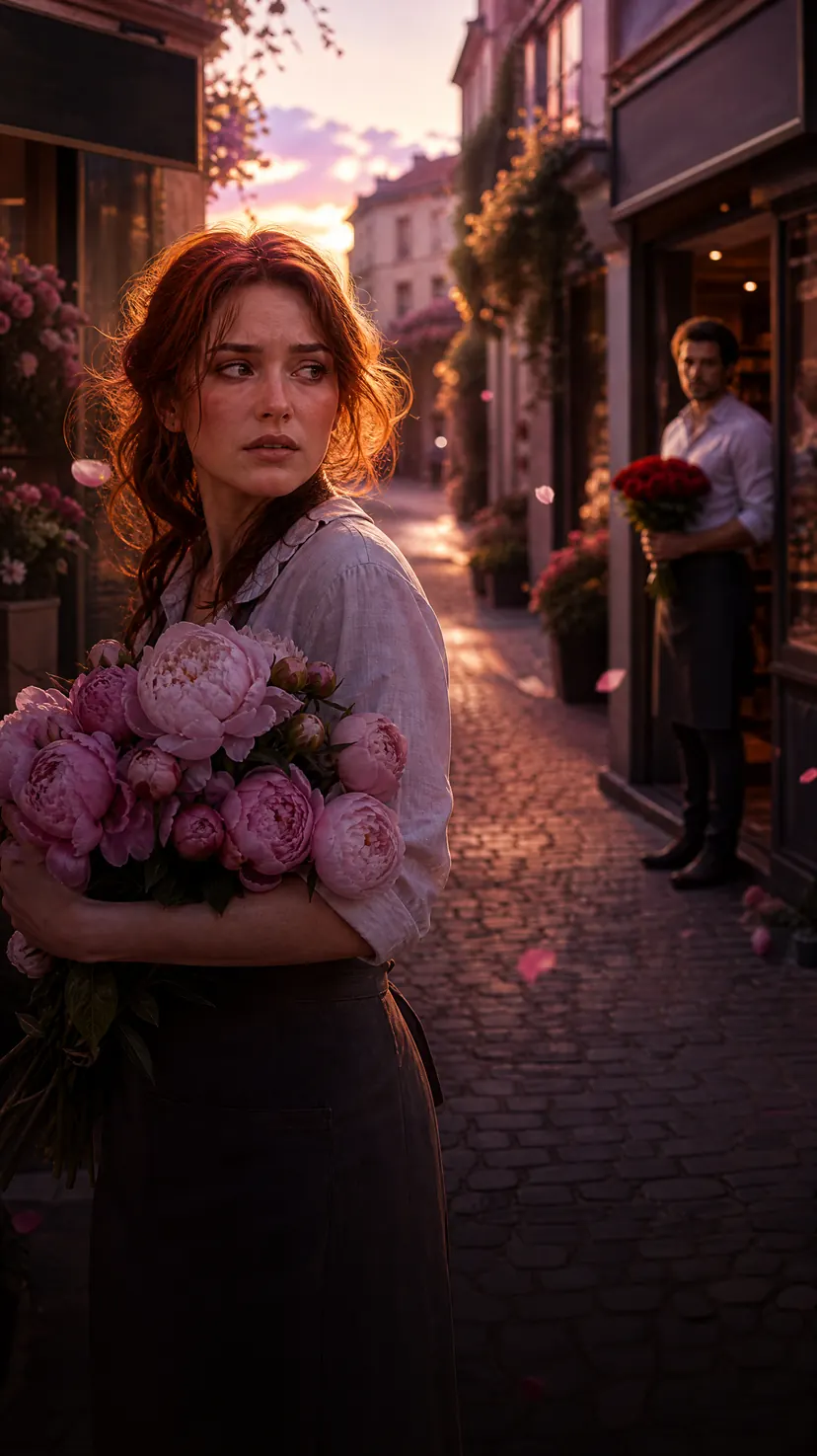
We drew up rules like a divorcing couple dividing the holidays.
I wrote them on the back of an invoice at my counter on Friday morning while Theo stood on the customer side with his hands in his pockets. Dot sat on the stool by the till and pretended to do the ordering.
"One," I said, writing. "I do the ceremony arch and the aisle. You do the reception tables. Nobody touches anybody else's flowers."
"Fine."
"Two. We meet only to approve colors, and only in public places."
"Fine."
"Three. No talking about anything except the wedding."
"Define anything."
"Anything, Theo. The weather. Your tan. Where you got the tan. My step."
"Your step's off limits?"
"My step is a protected site."
Dot made the kettle noise again. I pointed the pen at her without looking and she turned it into a cough.
"Four," I said. "You tell me why you dropped your portfolio when Celeste said Graham Pike."
He went still. It was a particular kind of still I remembered from when we were young, the stillness of someone who has decided to say nothing and is waiting for the moment to pass.
"That one's not about the wedding," he said. "Breaks rule three."
"Rule four overrides rule three."
"That's not how rules work."
"They're my rules."
"Then they're not rules. They're wishes." He took the pen gently out of my hand and initialed the bottom of the invoice. T.M., in blue ballpoint, because the green fountain pen was apparently for special occasions. "First color meeting Monday. I'll pick the place. Somewhere public."
He was gone before I could tell him I would pick the place.
He picked Café Marguerite.
I knew it from the corner of Tanner Street, before I even saw the door. The striped awning was faded now. The chalkboard still offered a ginger cake I had never once seen in the case. The window still had the hairline crack in the bottom left pane, shaped like a lightning bolt, that I had traced with my finger on a wet Sunday eight years ago while a nervous boy with dirt under his nails tried to get a ring out of his jacket and dropped it into the sugar bowl.
I stood on the pavement for long enough that a man with a stroller had to go round me.
Inside, Theo had taken the same table. Of course he had. The little round one by the cracked pane with the wobbling leg. He had two coffees on it and a stack of color swatches and a sugar bowl, and he was watching me through the glass the whole time I stood there deciding whether to leave.
I went in. I sat down. I picked up a swatch of wine-red velvet and said, "This is too purple."
"It's the same red as the roses."
"Under candlelight it'll go purple. Everything goes purple under candlelight."
"You go gold," he said.
I put the swatch down.
A waitress with a silver ring through her nose came over and asked if we wanted anything else. The ginger cake, maybe.
"It's never in the case," I said.
"It's in the back," she said. "It's always been in the back. You just have to ask for it."
She went away. Theo bit the inside of his cheek. I looked very hard at the swatches.
"That's rule three," I said.
"I know."
"You picked this table on purpose."
"I did." He turned his cup on its saucer, a quarter turn, then another. "I didn't pick it to hurt you. I want you to know that. I picked it because I needed to say something to you somewhere that mattered, and this is the only place in the city that matters as much as the church, and I wasn't going to walk into the church."
The espresso machine shrieked behind the counter. A girl laughed into her phone at the next table. I kept my hands flat on the swatches so they would stay where I could see them.
"Say it, then," I said.
"I didn't leave because of you."
I had imagined this moment, in the beginning, so many times. Two in the morning, three in the morning, all the reasons a man runs from a church. He'd met someone. He'd panicked. He'd looked at me in the veil and seen the rest of his life and wanted a different one. I had built a hundred versions of the speech and in every one of them, at the end, I got to be cold and say something brilliant and walk away.
What I said was, "Then why?"
"I can't tell you that yet."
"You can't."
"Not yet. Not until after the wedding. There's someone I need to..." He stopped and pressed his thumb into the scar on his knuckle. "Seven years, I've been figuring out how to say this. I'm asking for two more weeks."
"Seven years," I said. "Not a call, Theo. Not a postcard. Not one line. Your father stood on my mother's porch with his cap in his hands because you couldn't even be bothered to do it yourself."
"I wrote to you."
The café went on around us. The machine, the girl on the phone, the clink of somebody's spoon.
"You did not."
"Every month." He wasn't looking at the swatches. He was looking at me. "The first of every month, for seven years. Eighty-four letters, Nora. I numbered them."
"I never got a single one."
"I know," he said. "I sent them to your mother's house. It was the only address I had."
The floor tilted. I put one hand on the table to stop it, and the wobbling leg rocked, and the sugar bowl slid an inch toward the edge.
Theo caught it. He set it back down in the middle of the table, very carefully, the way you put down something that matters.
"Ask her," he said. "Ask your mother what she did with them."