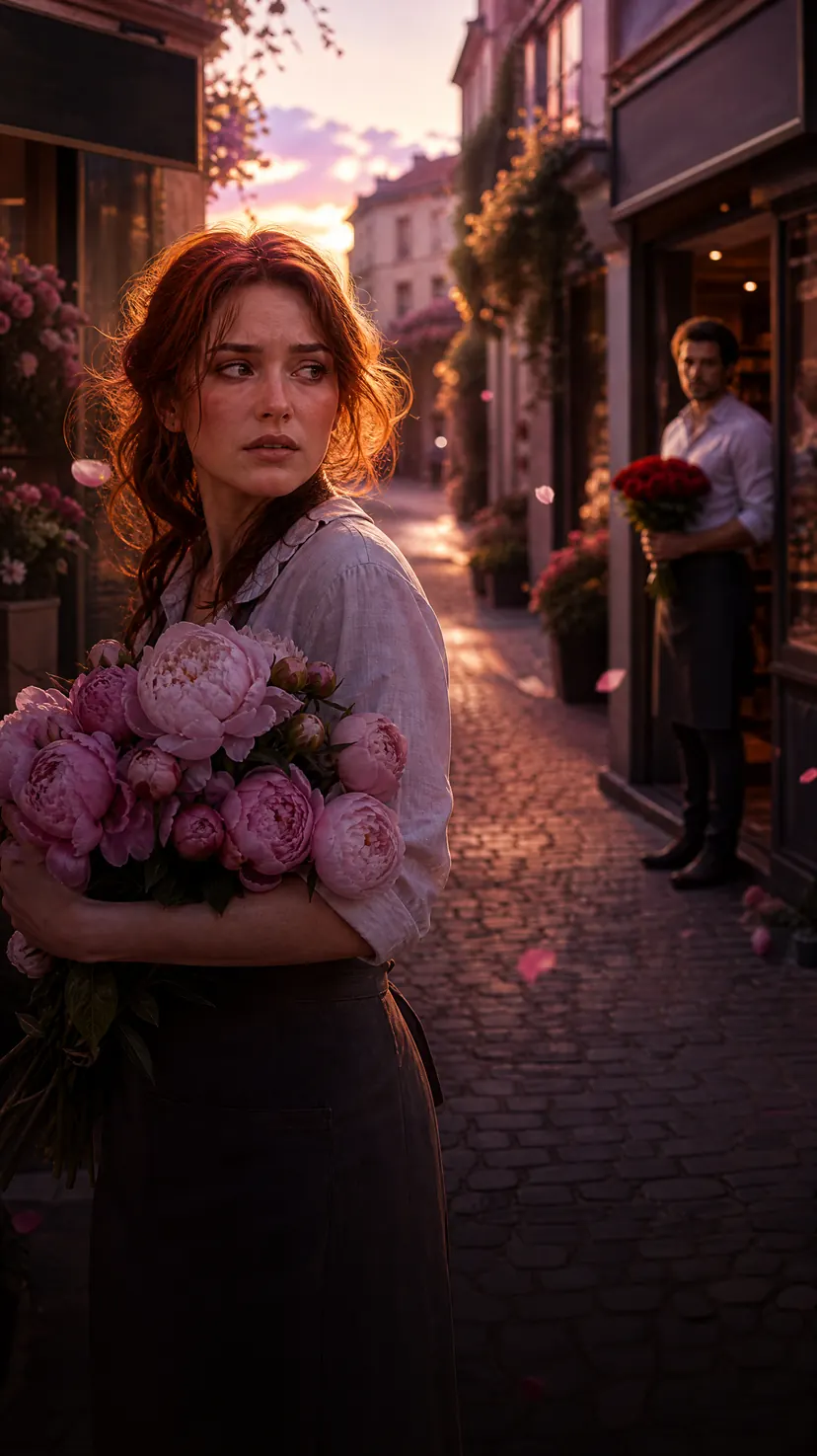
The flower market opens at three-thirty, and by four it sounds like a cathedral where everybody is arguing about money.
It lives in an old rail shed by the river, all iron girders and puddles and fluorescent tubes. Growers shout prices. Forklifts beep. The air is cold enough that you can see your breath above the buckets, and it smells of wet leaves and diesel and somebody's terrible coffee. I have bought flowers there since I was fifteen, when my mother first let me carry the cash bag. I know every stall. I know who soaks their roses to fake the weight and who keeps the good lisianthus under the bench for regulars.
So it was a particular kind of insult, on Thursday morning, to find Theo already there.
He was at Sal Fortunato's stall. Sal has sold me roses for eleven years. Sal came to my wedding, or to the church part of it, and afterward he drove to my mother's house with forty stems of apricot garden roses and left them on the porch without knocking.
Sal was laughing. His head was thrown back. He had one hand on Theo's shoulder.
"Bell!" Sal shouted when he saw me. "Look who's back from the dead!"
"Somebody should have checked the pulse," I said.
Sal's laugh went sideways. He looked at me, and then at Theo, and I watched the memory land on his face. He took his hand off Theo's shoulder and put it in his apron pocket.
"Nora," he said. "Your usual's under the bench."
"Thank you, Sal."
Theo didn't move. He was holding a sample stem, a red rose so dark it was nearly black at the edges, and he turned it slowly between finger and thumb.
"For the Ashworth pitch?" I said.
"For a bowl on my counter."
"Liar."
"You keep saying that."
"You keep doing it."
He put the rose back. "Celeste wants red. Did you know that? Her planner told me. She's been looking at your pink sketches for three months to be polite."
I hadn't known. Something cold went down through the soles of my feet into the wet concrete.
"Her planner talks too much," I said.
"Her planner likes me."
"Everyone likes you for about a week."
That one he didn't answer. He nodded at Sal, picked up his crates, and walked off between the stalls with his sleeves rolled and his breath going up in small white clouds. I stood there long enough that Sal said my name twice.
"I didn't know," Sal said, low. "I swear. He's been coming in since the spring, asking prices like a normal person."
"Since the spring?"
"Middle of March." Sal shifted. "Maybe end of February."
The shop opposite had opened on Saturday, the last Saturday in May. Theo had been in this city, buying roses, for three months at least.
The Ashworth house was on the hill above the park, three stories of pale stone with a gravel drive that made my old van sound like a cement mixer. A woman with a headset showed me into a waiting room full of white sofas and oil paintings of horses.
Theo was on the middle sofa with a black portfolio across his knees.
I took the armchair farthest from him. It was very low. My knees ended up near my ears and my own portfolio, which was green canvas and held together on one corner by tape, slid off my lap onto the rug.
He picked it up and handed it to me. He did not look at the tape.
"Pink," he said.
"Blush. With apricot. And some white."
"Peonies?"
"Garden roses."
"Coward," he said, very softly.
I opened my mouth, and the door opened too, and Celeste Ashworth came in like a gust of expensive weather.
She was twenty-eight, tall, with a cloud of black hair and a laugh that arrived a second before she did. She wore paint-spattered overalls, which I had not expected, and she had a pencil behind each ear.
"You came at the same time," she said. "Oh, that's lucky. I hate doing things twice."
We pitched to her at a long kitchen table while a dog the size of a pony slept on my feet. I went first. I showed her the arch, the cascades of blush and apricot, the jasmine I wanted to trail along the parapet so the whole roof would smell green and sweet by sunset. She looked at every page. She asked about the jasmine twice.
Then Theo opened his portfolio, and it was red.
Deep red, almost black at the edges. Low bowls on the tables, dark roses packed in moss, candles in old glass. It was gorgeous. It was moody and grown-up and nothing like what he used to do, and I could see Celeste's hand go to her mouth.
She looked from his pages to mine and back. She laughed, delighted, like a child given two puppies.
"You know each other," she said. It wasn't a question. "I can tell. You did that thing where you don't look at each other on purpose."
"We were at school together," Theo said.
"We were engaged," I said.
The dog woke up. Celeste's eyebrows went all the way up, and stayed there, and then she clapped her hands together once.
"Perfect," she said. "Then you won't kill each other. I want both. Her arch, his tables. You'll do it together."
"Miss Ashworth," I began.
"Celeste. And it's not my money, so don't worry about the budget, it's enormous." She pulled a pencil from behind her ear and wrote a number on the corner of my sketch that made my lungs stop working. "My fiancé's father is paying for all of it. You'll meet him at the rehearsal. He's very particular. He likes to know exactly who he's hiring."
She tucked the pencil away and smiled at us both.
"Julian's father," she said. "Graham Pike."
Beside me, Theo's portfolio slid off his knees and hit the floor, and every red page inside it fanned out across the tiles.