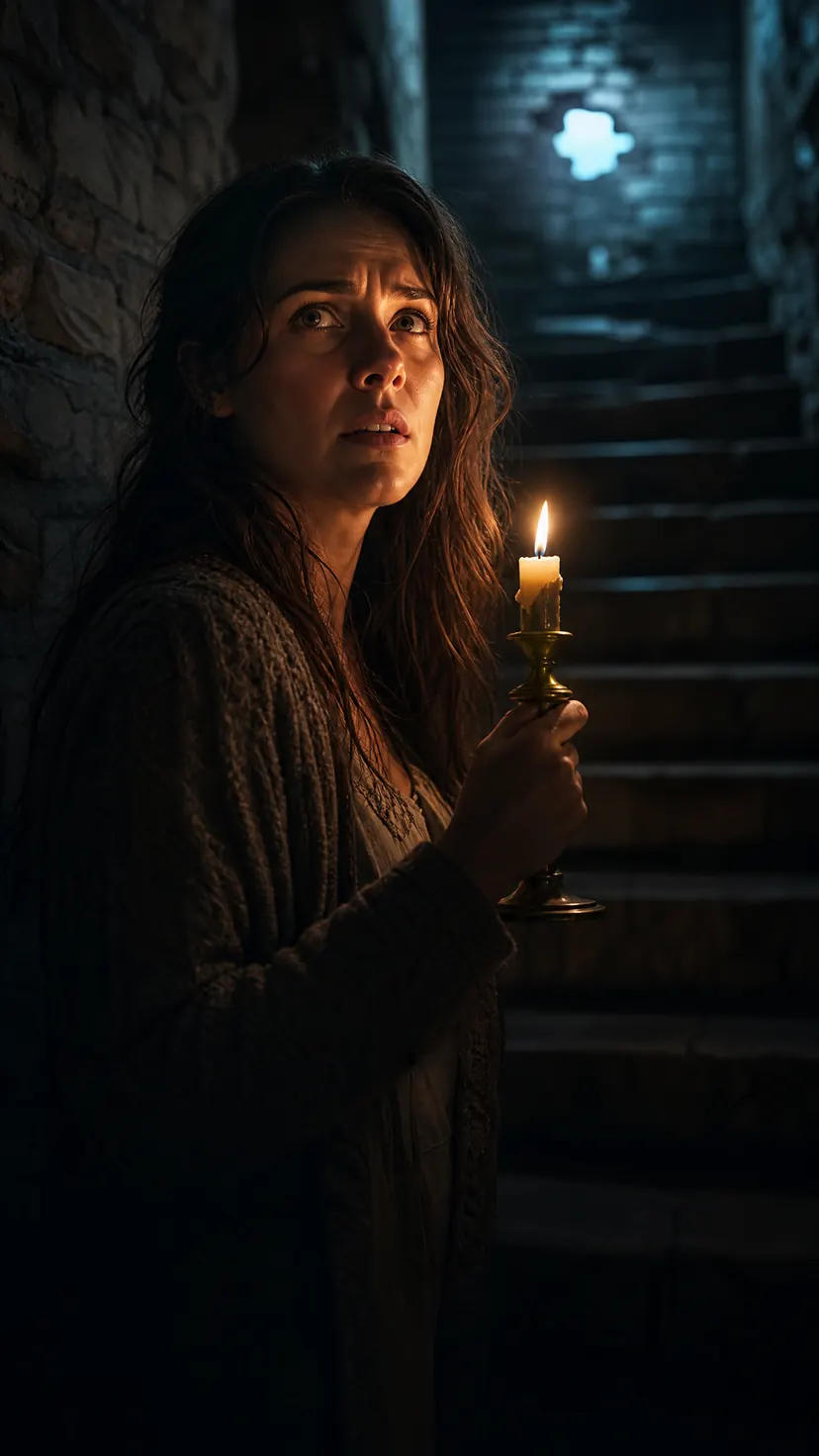
The attic was the only part of the house my grandmother had not kept in order.
I went up the next morning with the brass candlestick and a torch, because the attic had no bulb at all, and unhooked the little door at the bottom of the steps. The air up there was warm and close and tasted of a hundred summers. Trunks. Hatboxes. A dressmaker's dummy with no head. A rocking horse with one glass eye, its mane worn down to the canvas by somebody's small hands.
I sneezed four times in a row. Something scuttled away under the eaves.
My mother had never once talked about this house. When I was small I used to ask what her bedroom had been like, and whether she'd had a rocking horse, and she would change the subject so smoothly I'd be halfway through my supper before I noticed. Standing in the attic, I wondered which of these trunks she had climbed on, and whether she had ever tried to pick the lock on anything.
The key Mr. Pruett had given me lay in my cardigan pocket, where it had been since Brindle Market. I'd stopped noticing its weight. I noticed it now.
I tried it in every trunk. Two were unlocked and full of curtains. One held my grandfather's army uniform, folded with mothballs into creases sharp enough to cut. One had a lock rusted solid. The key didn't fit any of them.
The cedar chest was behind the rocking horse, pushed right back into the angle of the roof where the light didn't reach. It was smaller than the trunks, pale gold wood gone dark at the corners, and it had a brass padlock no bigger than a matchbox.
The key slid in as if it had been waiting.
The smell came out first. Cedar, and lavender, and under it the faint sour sweetness of very old milk.
On top lay a photograph in a card frame. Two girls on the village green in summer, squinting into the sun, arms around each other's waists. One was small and sharp-chinned, with a notebook sticking out of her skirt pocket. Margaret, without a doubt, fifty years younger and already looking at the camera as if she might ask it a question.
The other girl was taller, in a yellow dress, laughing at something out of the frame. She had long brown hair that wouldn't stay tidy. She had a crooked eyebrow, the left one, exactly like mine.
On the back, in pencil: S. and M., Fete Day, 1968.
I put the photograph face down on the floorboards and breathed for a while.
Under it, folded in tissue paper gone brown at the creases, was a christening gown. It was tiny, long, white once and now the colour of weak tea, with lace at the hem and a row of pearl buttons down the back. Sewn into the collar, in faded blue thread, was a name.
Sylvie Calloway, 1951.
The same blue thread as the loop on my key.
Below the gown was a knitted bonnet, yellow, only half finished. The needles were still in it. Twelve rows of stitches, then nothing, a ball of wool rolled up neatly beside it. Somebody had stopped in the middle of a row and never picked it up again.
Under the bonnet, a folded sheet of notepaper, pinned to the tissue with a dressmaker's pin.
My grandmother's handwriting. The steady hand, from before the ledgers began to shake.
She asked me to keep these for her. I told her I would. It was the last thing I said to her that was true.
I read it three times. Then I sat back on my heels in the dusty light and held the bonnet in my lap and tried to make the arithmetic of it come out any other way.
A girl in a yellow dress in the summer of 1968. A storm in October. A plaque that said lost, and a mother who wrote Forgive me in her accounts. A bonnet knitted for a baby, never finished.
Margaret Hollis with flour on her hands, saying, You have her eyes.
I didn't let myself think the next thought. I put the bonnet back in the tissue very carefully, the way you'd lay down something asleep.
Below me, the front door closed.
A soft, considered click. Someone shutting a door they had opened with a key, and did not want to be heard leaving.
I was on my feet before I knew it. My head hit a beam. I came down the attic steps half falling, with the torch swinging, and out onto the landing.
The candle was lit again.
Not the kitchen candle. That was still downstairs, in its saucer, where I'd left it. This was a new one, tall and cream-coloured, standing on the boards at the foot of the bricked doorway. It had been burning for no more than a minute. The match lay beside it, still faintly smoking.
Scattered on the stairs, from the landing down to the first turn, were yellow petals.
Close to the gap, very faint on the far side of the bricks, I heard the dry whisper of paper still settling on paper.
I ran down after the petals. Hall, front door, gravel. The lane was empty in both directions. The rooks in the churchyard elms lifted and settled, complaining.
Walter Finch was at the roses by the gate, in the same shiny cap, as if he had never gone home.
"Did someone just come out of my house?" I was standing on the gravel in my socks. I didn't care.
Snip. "Might have."
"Who?"
He wiped the blades of the secateurs on his trousers and looked past me, up at the top floor, at the square of red brick. "She had a key. She knew which stair creaks. She didn't need me to show her the way."
"Mr. Finch, who was it?"
He picked up his bucket. He took his time about it.
"Someone with more right to that landing than you've got, Miss Calloway," he said. "Or me. Or anybody left alive in Ashcombe."
Then he walked off down the lane with his bucket, and didn't look back once.