My grandmother left me her house, her fortune, and one rule: never open the room at the top of the stairs.
Mr. Pruett read the line twice. The second time he went slower, as if the words might rearrange themselves into something more reasonable while he watched.
"That's all?" I said.
"That's all she wrote." He took off his glasses and polished them on his tie. "Mrs. Calloway was very particular about the wording. She had me read it back to her four times."
His office sat above a bakery in Brindle Market, and the whole room smelled of warm bread and wet umbrellas. Rain ran down the window behind him. He had pushed a box of tissues across the desk when I came in. I hadn't touched it.
I had met my grandmother three times in thirty-two years. Once when I was five, in a garden, where she told me not to pick the roses. Once at twelve, when she came to our flat in Leeds and argued with my mother in the kitchen, so quietly I couldn't catch a single word through the door.
The third time was my mother's funeral, six years ago. My grandmother stood at the back of the crematorium in a black hat and left before the last hymn.
There had been two old women at the back that day, now I thought about it. The other one wore a green coat. I'd assumed she was a neighbour.
"I don't understand why she'd leave anything to me," I said.
"You're her only living relative."
"She didn't know me."
Mr. Pruett settled his glasses back on his nose. "She knew more than you'd think, Miss Calloway. She asked after you every year. Your job at the county records office. Your flat on Harrow Street. She was sorry to hear about the redundancy."
I had told exactly two people about the redundancy: my landlord and the woman at the job centre. I looked at the tissues and said nothing.
"The house is called Hollow Lane, after the road it sits on," he went on. "Stone, built around 1760, four bedrooms and an attic. There's money in the bank that will keep it standing for years if you're sensible. Everything passes to you without conditions." He tapped the page. "Except this."
"Is it a condition?"
"Legally? No. It's a request." He thought about it. "Morally, I'd call it a condition."
"What's in the room?"
"I have no idea. It's been bricked over since before I was born." He said it the way you might mention a church spire. "Ashcombe people don't talk about it. I'd advise you not to ask them."
"You know something, though."
"I know your grandmother paid me to call at that house every Tuesday for eleven years, to go through her post, and in all that time she never once let me past the bottom stair." He opened a drawer. "There's one more thing. She asked me to give you this."
It was a key. Small and brass, warm from the drawer, threaded on a loop of faded blue cotton.
"It doesn't fit any lock in the house," he said. "I've tried every one. She said you'd know where it went."
"I've never been to the house."
"Yes," said Mr. Pruett. "I did point that out to her."
Ashcombe lay eleven miles from Brindle Market, along a road that narrowed each time I thought it couldn't. Hawthorn scraped both sides of my car. Twice I reversed into a gateway to let a tractor past, and twice the farmer lifted one finger from the wheel and stared at me until I was out of sight.
I could have turned round. I had nothing much to go back to in Leeds: a rented flat with a damp patch on the bedroom ceiling shaped like Norway, a stack of job applications, and a letter from the council about my bins. I kept driving.
The village came up out of the valley all at once. A squat church tower. A green with a pump on it. A pub called The Plough, a shop with a sun-faded awning, a row of cottages with their doors painted different colours. Every window I passed seemed to have a face in it, or the twitch of a curtain where a face had just been.
Hollow Lane ran uphill past the churchyard and stopped at the house.
It was bigger than the photographs, and colder. Ivy had swallowed the east wall to the gutters. A slate lean-to clung to the side like an afterthought. On the top floor there were three windows. Two were dark glass. The third was a square of newer, redder brick where a window used to be.
I sat in the car with the engine off and counted the floors twice, as though the number might change.
The front door stuck and then gave. Inside, the hall smelled of lavender, coal dust and something sweetish I couldn't place. I found the switch. The bulb flared and popped, and the dark came back thicker than before.
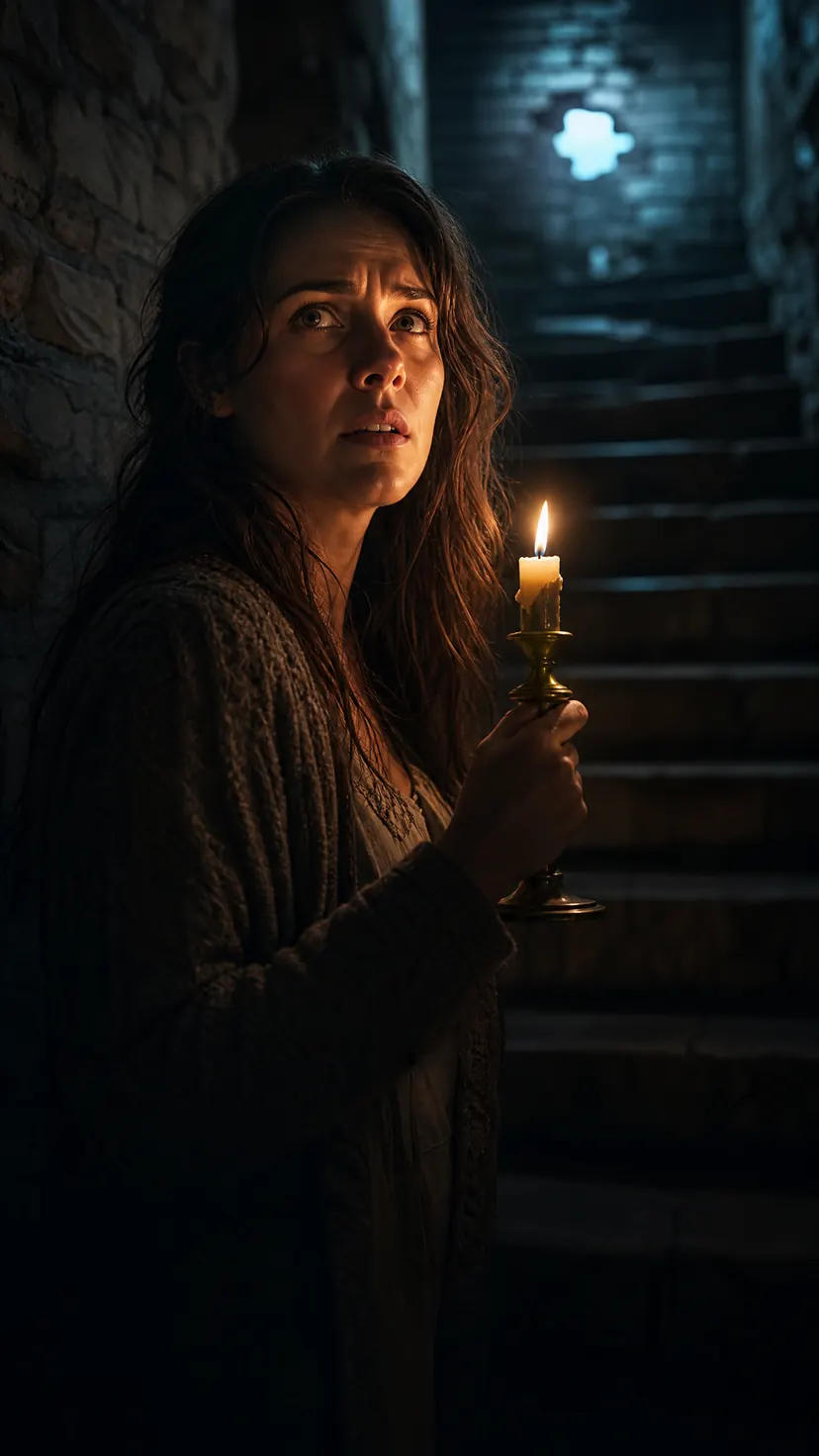
My phone torch showed me a hall table, a vase of dead chrysanthemums, and a brass candlestick with a box of matches beside it, neatly placed, as if someone had expected exactly this.
I lit the candle. The flame leaned toward the stairs.
They were stone at the bottom and oak higher up, and they turned twice before they let you reach the top. I told myself I was only going up to find a working bulb. I told myself that on every step.
At the second turn I stopped.
There was light on the landing already. Low and yellow, moving slightly, like breath.
A candle stood on the bare boards at the foot of the bricked doorway. A plain white kitchen candle in a saucer, burned perhaps an inch.
I knelt and touched the wax at its rim. It was still soft.