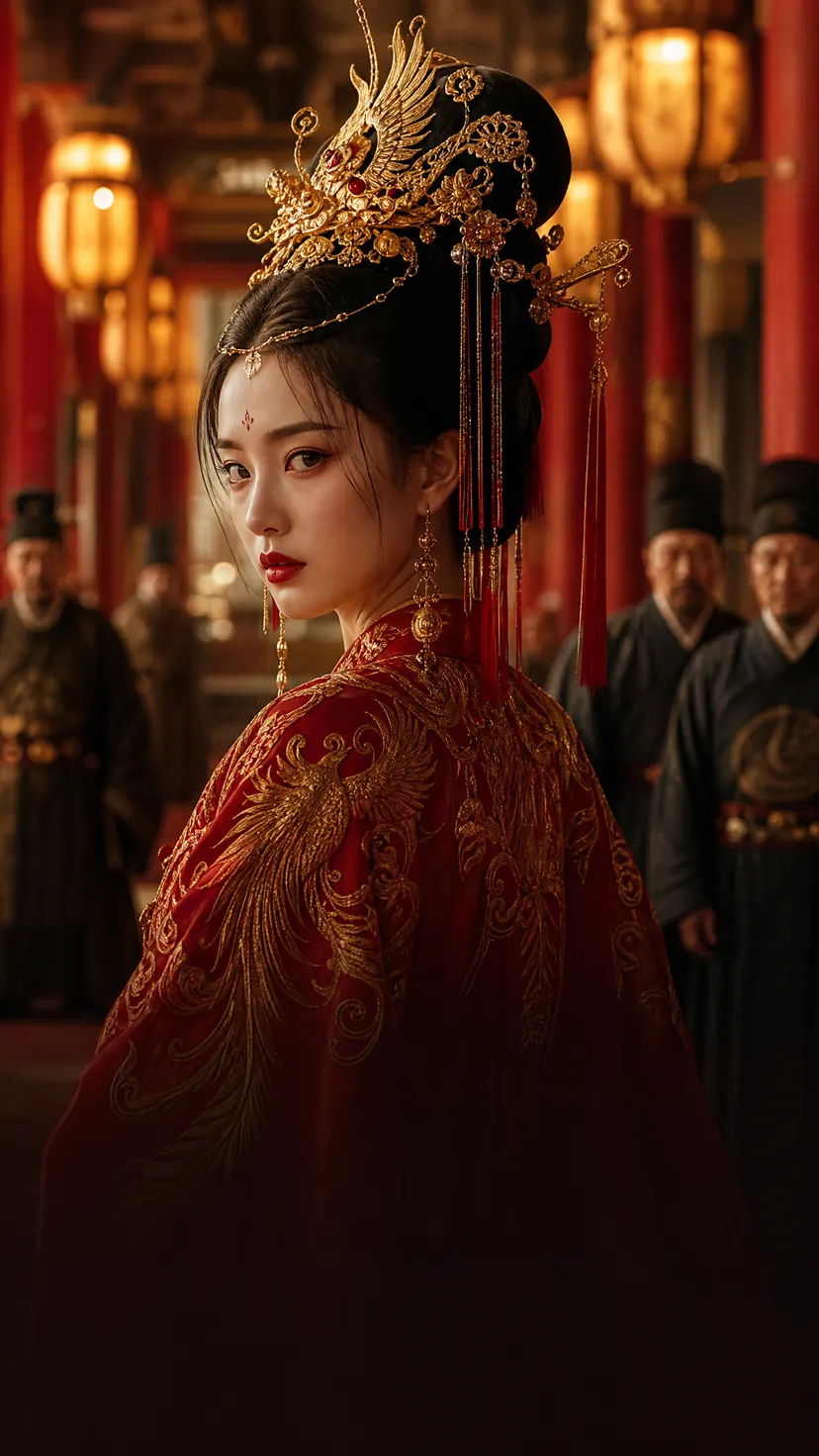
On the morning she died, Empress Lian counted the seals on her own death warrant and found one she did not recognize.
There were nine. The clerk held the scroll open at the edge of the platform so the crowd below the Meridian Gate could see the red stamps marching down the paper, and Lian, kneeling with her wrists bound behind her, had nothing to do but read.
Minister Luo's square seal, heavy and proud. Chief Eunuch Pan's neat oval. The Duke of Rong, and beside him his daughter the consort, who had wept so prettily at the trial. Censor Hu. Physician Qin. General Yan. The cramped little stamp of Treasury Clerk Bai, who had spent three weeks forging her handwriting and had once apologized to her in a corridor with tears on his face.
Eight names she knew.
The ninth seal was a plum blossom. Five petals, carved small, pressed in ink the color of old liver. She had never seen it in her life.
"Shen Lian," Censor Hu read, in the voice he saved for festival proclamations. "Formerly Empress of the Jingyuan court. Convicted of treasonous correspondence with the northern rebels. Convicted of forbidden arts. Convicted of the murder by poison of an imperial child not yet born."
The rain had started before dawn. It ran off the eaves of the gate tower and dripped onto the boards in front of her, and she watched one drop slide along the grain of the wood and vanish into a crack. Her knees had gone numb an hour ago.
The crowd said nothing. That was the strangest part. She had ridden through these streets at the Lantern Festival and they had thrown peony petals at her sedan. Now they stood under oiled umbrellas and waited, polite as guests at a dinner where the host has suddenly gone pale.
Behind the screen of officials, on the covered dais, a man coughed.
She knew that cough. She had heard it across a pillow for ten years, on winter nights when he worked too late over memorials and fell asleep with his brush still wet. Zhao Heng. Emperor of the Jingyuan reign, Son of Heaven, her husband. He coughed again, softly, the way a man clears his throat before he speaks.
He did not speak.
Lian shut her eyes. So that was the answer. In the cell she had wondered whether he would come, and whether he would stop it. Now she knew, and it hurt less than she had expected. It felt like reaching for a stair in the dark and finding air.
"Sister."
Her eyes opened. Shen Qiao had climbed the platform steps. The guards let him through; he was Vice Minister of Rites now, their father's heir, and his face was wet with more than rain. He knelt in front of her in the mud, ruining his good blue robe, and reached around her to press something into her bound hands.
Cold metal. A long pin. Her fingers knew it before her mind did. Their mother's phoenix hairpin, gold, with a red stone set in the bird's eye. Their mother had been buried with it.
"So you don't go alone," Qiao whispered. His hands closed over hers and held on.
"Qiao. Where is Father?"
"Ill. He couldn't come." His thumb moved across her knuckles. "I'm here. Hold it tight."
She held it. The executioner stepped up beside them and said, almost gently, "Lord Shen. You must move now."
Qiao did not move. He kept his hands over hers. She felt his breath catch and thought he was crying, and she was so grateful it scooped her out like a spoon.
The blade lifted. She heard it go up, a thin whisper of wet steel.
Something pulsed in her fist, hot, as if the pin had grown a heart.
Then nothing at all.
Then a voice.
"Miss. Miss, wake up. You'll be late, and Madam will have my ears in a soup."
Lian opened her eyes on a ceiling painted with cranes.
She knew those cranes. Seven of them flying in a ring around a faded sun, one with a chipped wing where her brother had hit it with a shuttlecock when she was eight. Her childhood bedroom in the Shen house on Willow Lantern Street. Camphor from the clothes chests. Sparrows squabbling on the roof tiles.
She sat up too fast and the room tilted.
"Tao," she said.
The maid at her bedside was fifteen, round-cheeked, holding a basin of warm water with a towel folded over the rim. Tao, who had been beaten to death in the Censorate cellars two months before the trial because she would not sign the confession they had written for her. Tao, who hummed the same three lines of a fishing song every morning while she combed Lian's hair, because she could never remember the rest.
"Miss? You're crying." Tao put the basin down. "Was it a bad dream? It's nerves. My aunt threw up in a bucket the morning of her wedding."
"My wedding," Lian said.
Tao laughed, uncertain. "Today, miss. The palace sedan comes at the hour of the snake. You marry the Emperor today."
Lian looked down at her hands. Smooth. No rope burns at the wrists, no ridge on the middle finger from ten years of brush and seal. Twenty-year-old hands.
The right one was clenched so hard the knuckles had gone white.
She opened it slowly.
Across her palm lay her mother's phoenix hairpin, the red stone in its eye glowing like a coal in a banked stove. It should have been sealed in a coffin in the family cemetery. It should have been on a wet platform, in a dead woman's fist.
It was warm. And along its sharp end ran a thin brown line of dried blood that did not belong to her.