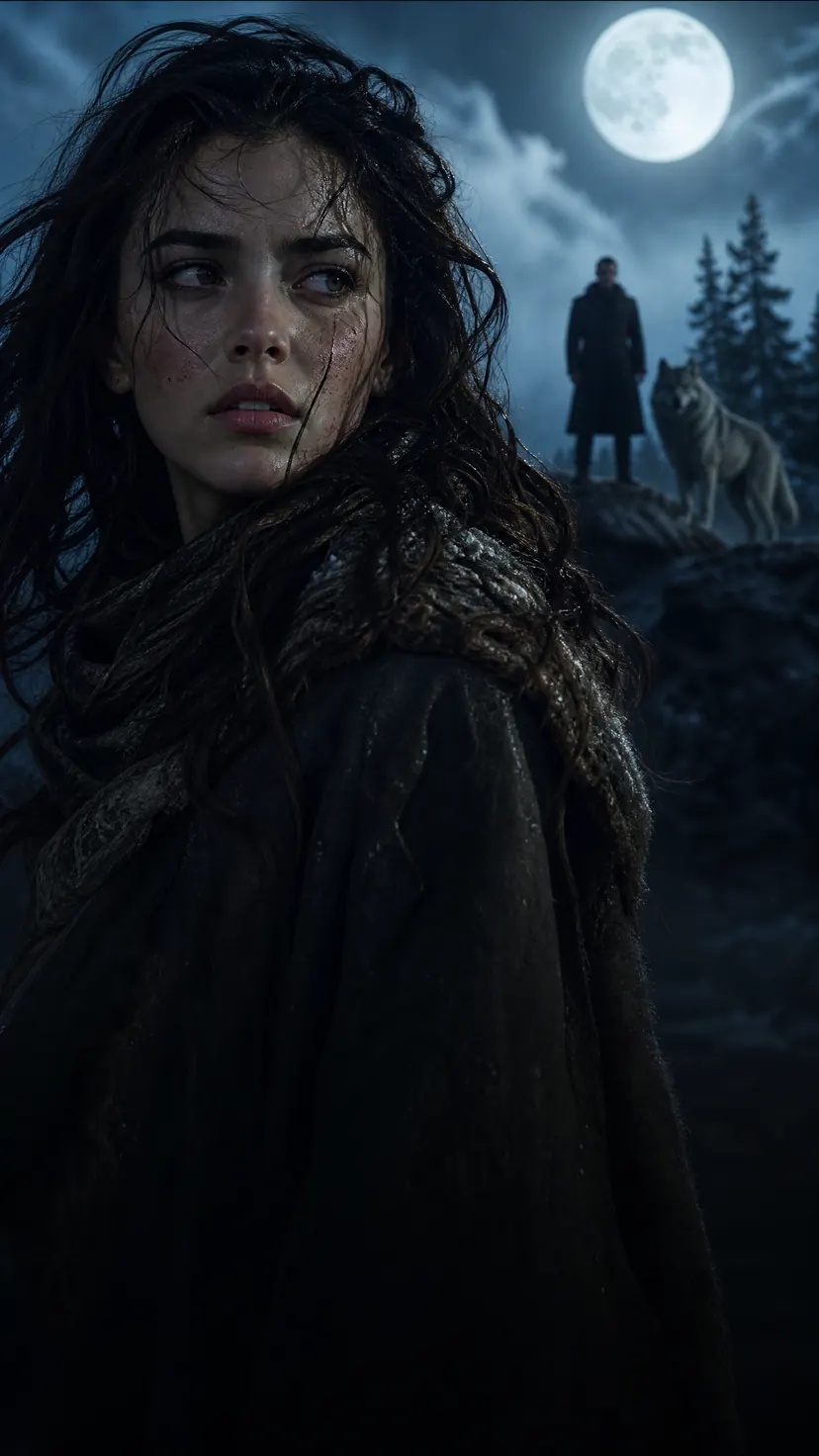
On my fourth night out of Larch Hollow, the grey wolf came limping into my firelight with its left ear torn half through.
It had followed me for three days by then and never once come closer than the length of a barn. Alone on a logging road with forty dollars in a sock, you'll talk to anything. "If you're going to eat me," I'd told it the first night, "do it before I fall asleep." In the morning there'd been a rabbit on the flat rock by my boots, neck broken, still warm. I didn't eat it. I was a wolf's daughter and I knew what that rabbit was: an offering. You don't take an offering from something you don't know.
Now it stood at the edge of the light with blood matted black down its jaw, like it had been in a fight somewhere in the dark while I slept.
"Oh, you idiot," I said. "What did you do?"
It sat. It let me. It sat by the fire like a dog at a back door and let me kneel in front of it with Crewe's tin open on my knee.
The salve smelled of cut grass and pennies. I worked it into the torn edges with my fingertips. The wolf's breath was hot on my wrist. I couldn't smell the wolf at all. Since the meadow my nose had gone as dead as the rest of me, and the whole world smelled of wet cardboard.
"You're going to have a notch there," I said. "Forever. You'll look like a pirate."
It made a sound low in its chest. If a wolf can laugh, that was it.
In the morning it was gone. Just a flattened patch of bracken, still warm, and a long grey hair caught on my coat sleeve.
Port Calder smelled of diesel and fish guts and frying onions, and nobody there had ever heard of Larch Hollow.
I found a room above a bait shop on Ferrier Street. The landlady, Mrs. Pell, had a smoker's laugh and a ledger she kept in a biscuit tin. "Sixty a week," she said, looking me over: the boots, the duffel, the grass still caught in my laces. "You running from a man, love?"
"Sort of."
"Sixty a week," she said again, softer, and gave me the key.
I got a job at the Gull and Kettle, a diner on the harbour road that never closed because the fishing boats never stopped coming in. Night shift, ten until six. I was good at it. I carried four plates on one arm, and I learned to slow down so nobody noticed.
The first winter my wolf was silent.
Crewe had said she'd go quiet. Nobody told me how quiet. All my life she'd been there under my skin, a warmth, a second heartbeat. Now there was nothing. I'd wake at three in the afternoon in Mrs. Pell's back room with the gulls screaming and feel for her the way you'd feel for a missing tooth.
Rejected wolves sicken. Everyone in the Hollow knew it. By January I'd stopped being hungry, and I understood that if I waited for my wolf to come back on her own there'd be nothing left for her to come back to.
So I made up my mind to wake her. One full moon. One change. My mother's first rule, broken once, to prove there was still something under my skin worth keeping a rule for.
I swapped my shift with Dev, the cook. At eleven I walked out past the rail yard to the marsh behind the cannery, where the reeds stood higher than my head. I took my coat off and folded it. I took my boots off. The mud had frozen in ridges that cut my feet. I knelt in it in my slip and reached inside for her, the way you'd lower a bucket into a dark well.
Nothing came up.
I knelt there until the moon stood overhead, and then until it was going down. I called her the way you'd call a dog home at dusk. I begged. The cold went into my knees and then my hands and then my chest, and somewhere around four in the morning I stopped feeling it, which is when you're supposed to worry.
Dev found me at seven, walking the cannery road barefoot with my boots in my hand. I don't remember that. I remember his car heater, and him saying "Jesus, Wren," over and over like a prayer.
Pneumonia. Three weeks flat on my back. Every cent I'd saved went to a doctor, and my night shift went to a girl from the ferry office. When I could stand I asked for days instead, at half the money, and took them.
That was the price. That, and this: I never tried again. I'd reached for her with everything I had and found an empty room, and after that I was afraid to look.
Dev told me later there'd been prints in the frost along the cannery road that morning, big ones, beside mine all the way to the marsh. Somebody's dog, he said.
My mother wrote once a month. No return address, no stamp. The letters just turned up under my door, which meant someone carried them. The weather in the Hollow. Who'd had a baby. Never a word about Cade, never a word about why. I wrote back to Crewe's name and left the letters on the windowsill, and they were gone by morning.
The second spring, I saw the grey wolf again. Fog off the harbour, six in the morning, rows of rusting boxcars at the rail yard, and something standing at the end of the row, sixty yards off. Grey as wet slate. Pale blaze. And on the left ear, a notch.
"You," I said.
It turned between two cars and was gone.
After that I saw it every full moon, at the rail yard, at the edge of the marsh, once on the shingle beach at dawn, knee-deep in the cold surf like it was keeping watch on the water. I started leaving things. Bacon from the diner wrapped in wax paper. They were always gone by the next night.
Four years. I got promoted to day manager. I saved two thousand dollars in a coffee tin behind the loose skirting board.
I stopped dreaming of running.
In August, my mother's letters stopped.
In October, the week of my twenty-second birthday, something was waiting under my door when I came home from the late shift. A square of brown paper folded twice. No stamp. Crewe's handwriting, cramped and slanting, like a fence in a high wind.
One sentence.
Come home. He is dying, and he is asking for you.