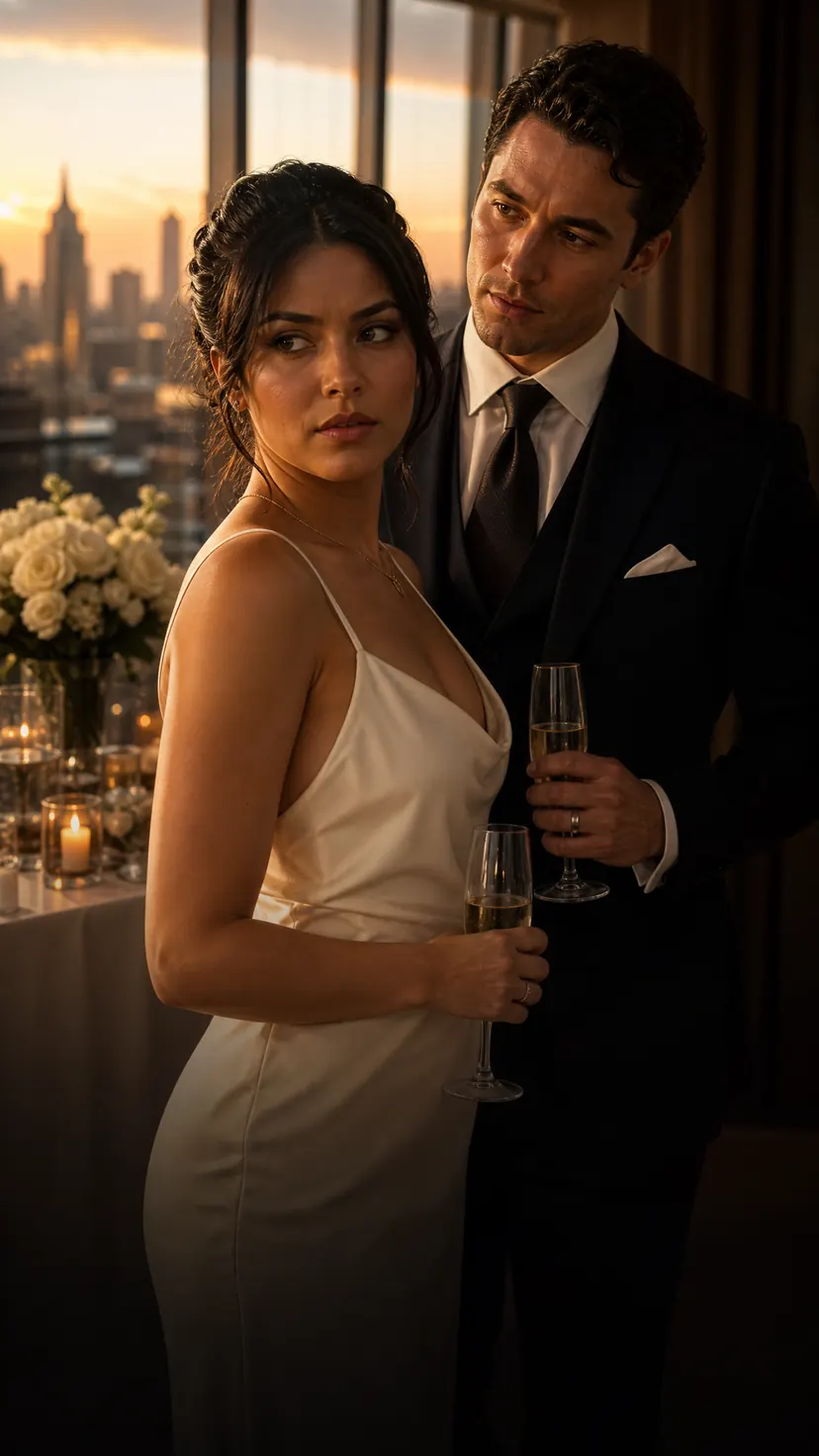
The orchids at the Ferrante Foundation gala were real, and Ana knew exactly what they cost, and she was standing in front of them for that reason when Vivienne Strand found her.
"Mrs. Hartley." A cool hand touched her elbow. "Finally. You're very hard to get alone."
Ana knew the face. Everyone in the city knew the face. Silver bob, red mouth, a column in the Sunday Ledger called The Glass House that had ended two engagements and one congressional campaign last spring. Vivienne wore black and a single diamond, which in this room was the equivalent of arriving in armour.
"Ms. Strand. I love your work."
"No, you don't." Vivienne smiled with all her teeth. "But you're polite. That's refreshing. Most of Dominic's women have been decorative."
"Most?"
"Two. Both blonde. Neither lasted a season." She plucked a glass from a passing tray without looking at it. "You're the first one he married. Nine days from engagement to altar. A planner, no less. You must be very good at your job."
"I am."
"I can tell. It was a beautiful wedding. Very romantic. I wept." Vivienne sipped. "How's the bakery?"
Ana kept her smile exactly where it was. It took effort. It felt like holding a tray of full glasses on one palm.
"Busy," she said.
"Is it? I heard the rent was four months behind in August. And then, miraculously, in September it wasn't." Vivienne tilted her head. "Corliss Avenue, isn't it? Lovely street. Your father makes a guava pastry I'd sell my mother for."
This was the third gala. The contract required eleven. At the first, Ana had worn borrowed navy and said nine sentences, all of them about the weather. At the second, Dominic had stood beside her for two hours with his hand at the small of her back and not said a single word to her, which the society pages had described as "smouldering" and Mateo had described as "hostage video."
Neither had prepared her for a woman who knew about the guava pastries.
"If you're asking whether I married for money," Ana said, "I'd say it's a strange question to ask a woman holding a champagne flute that costs more than my first car."
"I'm asking," Vivienne said pleasantly, "what he's paying you. And whether it's enough. Because if it isn't, I pay very well for a good story, and a mercenary bride is always a good story."
Across the room, past the string quartet and the ice luge and a minor royal of somewhere eating a shrimp, Dominic looked up.
Ana didn't see him notice. She saw what happened after. He was speaking with three men in identical grey suits, and in the middle of a sentence he simply stopped, set his drink on the tray of a startled waiter, and walked away from them.
He didn't hurry. Dominic Hartley never hurried. He crossed the ballroom like weather coming in off the water, and people moved out of his way without seeming to know why.
"Vivienne," he said, arriving.
"Dominic, darling. I was just congratulating your wife."
"I heard." He didn't look at Ana. He didn't have to. His hand found hers at her side and closed around it, warm and dry and very steady. "You were asking about her family."
"Background. You know how I like a little colour."
"My wife," Dominic said, quietly enough that only the three of them and possibly the orchids could hear, "is not a story. Not this season. Not any season. If her name or her father's name or the name of that street appears in your column, I'll buy the Ledger and have your desk moved to the loading dock. I'd enjoy it, Vivienne. I've never owned a newspaper."
Vivienne's smile didn't move, but her eyes did. They went from his face to their joined hands and back, and Ana watched her decide something.
"Message received," the columnist said lightly. "Enjoy your evening, Mrs. Hartley. You've clearly earned it."
She went. The air came back into the room.
"You can't buy a newspaper because somebody was rude to me," Ana said.
"I can, actually. It's very easy. Nobody wants them."
"Dominic."
"Terrace," he said, and steered her through the long glass doors before she could argue.
It was cold outside. October had arrived in the last week, sharp and clean, and the city lay below them in strings of light. There was nobody on the terrace. No photographers. No Felix with a stopwatch.
He still hadn't let go of her hand.
She looked down at it. He looked down at it too, as if noticing for the first time, and then he looked away at the river and left it exactly where it was.
"There are no cameras out here," she said.
"I know."
"So you can stop."
"I know," he said again, and didn't.
She should have pulled away. Clause nine was right there, firm and sensible. Instead she stood beside him and listened to the quartet through the glass, and after a while she said, "The piano. At night. The same eight bars."
His thumb went still against her knuckles.
"You can hear that?"
"The walls are very expensive. They're not soundproof."
He was quiet for so long she thought he wouldn't answer. Then he said, "It's something my mother used to sing. I was too young to remember the words. I remember the first eight bars, and then it stops. I've tried every songbook. I hired a musicologist once. Nobody knows it."
Ana opened her mouth. Shut it. Somewhere at the back of her memory, under ten years of other people's weddings, something flickered and went dark.
"I'm sorry," she said, which was true and useless.
"Don't be." He turned her hand over, looked at the palm as if there were something written there, and finally let go. "Come inside. I'm told there's a regatta committee I'm supposed to charm."
"You don't charm."
"No," he admitted. "I mostly stand near people until they agree."
She laughed, a real one that surprised them both. Then she went to the ladies' room to fix her lipstick and give her face a minute to be her own.
Her evening bag was on the marble counter. She had left it with Dominic's coat earlier, with the staff by the door. Now, opening it for her lipstick, she found something new.
A business card. Heavy cream stock. VIVIENNE STRAND, THE SUNDAY LEDGER, embossed in black.
On the back, in fountain pen, a single line in a slanting hand.
Ask him what he was doing on Corliss Avenue in February.
Someone knocked on the outer door. "Ana?" Dominic, low, meant only for her. "The car's downstairs."
She looked at the card. Then at the door. Then at her own face in the mirror, which was waiting to see what she would do.
"Coming," she called.